Key takeaway
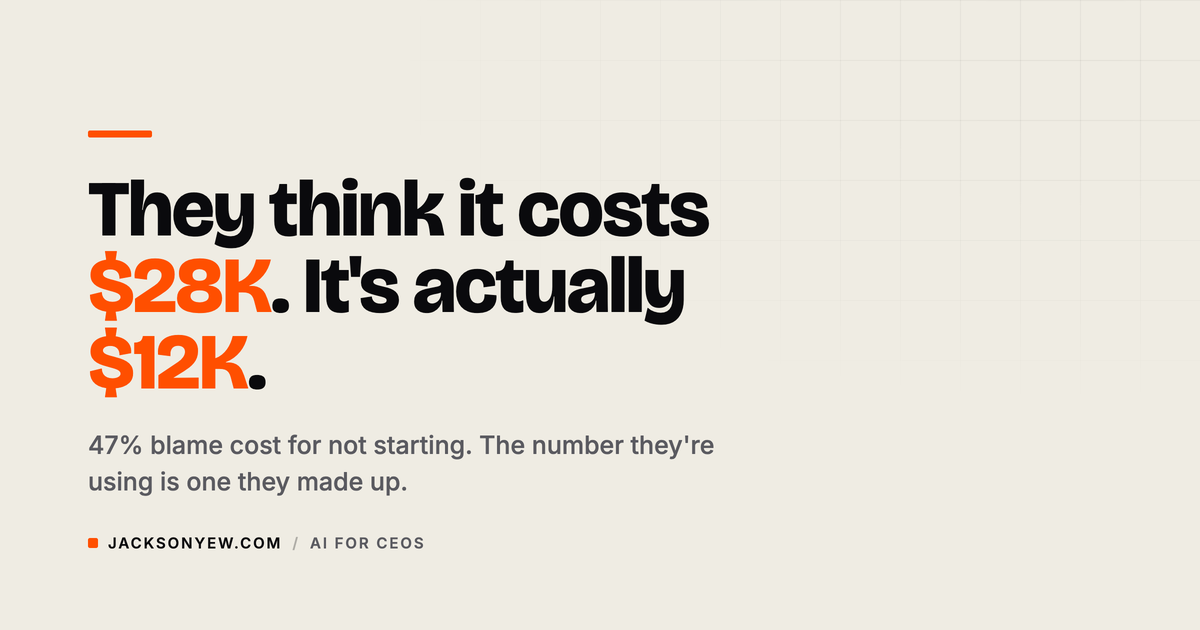
47% of Americans cite cost as the top reason they haven't started a business.
Updated : Refreshed source citations, internal links, and formatting throughout.
The number one reason people don't start is a number they made up.
Specific data destroys the excuse. Here's what it actually costs.
QuickBooks' Entrepreneurship Trends 2026 report put two numbers side by side that I have not been able to stop thinking about.
47% of Americans who want to start a business cite cost as the top reason they have not done it yet. The same survey asked people how much they think it costs to start. The average answer: $28,000.
The actual median startup cost across small businesses in the US: $12,000.
That is a $16,000 gap. Not between what people can afford and what it costs - between what people imagine it costs and what it actually costs. The barrier is not financial. It is perceptual.
94% more US adults plan to start a business in 2026 compared to last year. 57% say they will launch even if the economics look difficult. People are not avoiding entrepreneurship because they genuinely cannot afford it. They are avoiding it because the number in their head is wrong.
The psychology of overestimating starting costs
We systematically overestimate the cost of new things, especially things that involve risk. It is a cognitive protection mechanism. The higher the imagined cost, the more defensible the decision not to try.
$28,000 is not a random number. It is a number that makes inaction reasonable. If it costs $28,000 to start, you probably need to save up first, research more, build a more complete plan, wait for the right moment. The high imagined cost creates a permission structure for delay.
$12,000 destroys that permission structure. $12,000 is achievable. It is a few months of savings, a modest line of credit, or a part-time project running alongside a day job. The rational response to "it costs $12,000" is completely different from the rational response to "it costs $28,000."
The other distortion worth naming: we compare the cost of starting against the cost of staying. We treat "starting a business" as a financial risk and "staying at a job" as the safe default. But staying has costs too. The income ceiling. The time you do not own. The compounding of years spent building someone else's asset instead of your own. Those costs are real but they are invisible because they are not denominated in a number you have to write down.
What $12,000 actually buys you in 2026
The era we are in right now is genuinely the cheapest in history to start a knowledge-based or service-based business. That is not optimism. That is the structural consequence of what AI tools have done to production costs.
A content business five years ago required: a website (design, hosting, development), production equipment for video and audio, editing software, distribution tools, and often an assistant or contractor for what you could not do yourself. The startup budget for a credible online presence ran $15,000 to $30,000 before you had sold a single thing.
The same business today:
Website and landing pages: $20 to $50 per month on no-code platforms (Webflow, Carrd, Squarespace). Design assistance from AI tools. No developer required.
Content production: a decent smartphone camera, a $100 microphone, and free or low-cost editing tools. AI tools handle caption writing, post scheduling, and content repurposing.
Business operations: accounting software, email marketing, payment processing, CRM - all available under $200 per month in bundled SaaS tools. Most start for free until revenue justifies the upgrade.
Branding and design: AI design tools handle logo, graphics, and template creation at a fraction of the cost of freelance design work.
What $12,000 buys in 2026 is not what $12,000 bought in 2020. The purchasing power of that capital, directed at the right stack of tools, gets you a fully operational content or service business with runway to reach your first 90 days of revenue.
Three business models and what they actually cost
The range of startup costs depends significantly on the business model. Three categories worth breaking down:
Digital product business. A course, a template, or an ebook sold through a platform like Gumroad, Teachable, or Kajabi. Startup cost: under $2,000 for platform setup, basic branding, and initial content production. The capital requirement is time, not money. The median startup cost here is closer to $500 to $2,000.
Service business. Consulting, coaching, copywriting, design, marketing. Startup cost: your professional tools, a website, and a payment processor. Under $5,000 for a fully operational service business. Many service businesses have started on zero capital with a few client conversations and a PayPal link.
Content-first business. Newsletter, YouTube channel, or social media presence with a monetization plan. Startup cost: equipment and tools ($500 to $2,000), platform subscriptions ($100 to $300 per month), and time. The capital outlay is low; the time investment is high. Monetization arrives when the audience is large enough - which on the newsletter side takes a median of 66 days per Beehiiv's 2026 data.
None of these models require $28,000. Most of them do not require $12,000. The median is pulled up by businesses that involve physical product, equipment, or inventory - categories where the capital requirement is genuinely higher.
For knowledge-based or service-based businesses, the cost barrier is not money. It is decision.
The question the $12,000 number actually raises
If the real cost is $12,000 and 47% of aspiring founders are sitting on a cost excuse built on a $28,000 myth - what is the real barrier?
My read: it is not money. It is identity. The transition from "someone who thinks about starting" to "someone who has started" is not a financial decision. It is a self-concept decision. The money excuse is load-bearing for a different kind of hesitation - the fear of trying and finding out what happens.
That fear is legitimate. Starting is a test. The outcome is uncertain. But the excuse - "I can't afford it" - is not the real reason most people do not start. And it should not be able to survive contact with the actual number.
$12,000. That is what it costs.
Related: Jackson's story and work with Jackson.
FAQ
How much does it really cost to start a business in 2026?
QuickBooks' Entrepreneurship Trends 2026 report puts the actual median startup cost across US small businesses at $12,000. People imagine it costs $28,000 on average. That $16,000 gap is not between what people can afford and what it costs. It is between what they imagine and what is real.
Why do people overestimate startup costs by so much?
We systematically overestimate the cost of risky new things as a cognitive protection mechanism. A higher imagined number makes inaction defensible. If it costs $28,000, you can reasonably tell yourself to save up, research more, and wait. $12,000 destroys that permission structure because it is achievable with a few months of savings or a side project.
Does a knowledge or service business actually need close to $12,000?
No. The $12,000 median is pulled up by businesses with physical product, equipment, or inventory. A digital product business can start under $2,000, often closer to $500 to $2,000. A fully operational service business runs under $5,000, and many start on zero capital with a few client conversations and a payment link.
If money is not the real barrier, what is actually stopping people?
The post's read is identity, not money. Moving from someone who thinks about starting to someone who has started is a self-concept decision, not a financial one. The cost excuse is load-bearing for a different fear, the fear of trying and finding out what happens. That fear is legitimate, but the $28,000 number is not the real reason.
Sources
- 2026 Entrepreneurship Trends: Business Intent, Money Barriers & AI Tools Intuit QuickBooks · December 18, 2025
- The State of Newsletters 2026 beehiiv · January 6, 2026