
Key takeaway
AI lets companies cut headcount while raising productivity, and because large firms take years to restructure, lean solo operators have a temporary window to rebuild around AI in days and gain an asymmetric advantage.
Updated : Refreshed source citations, internal links, and formatting throughout.
Morgan Stanley surveyed 1,000 executives across 5 countries.
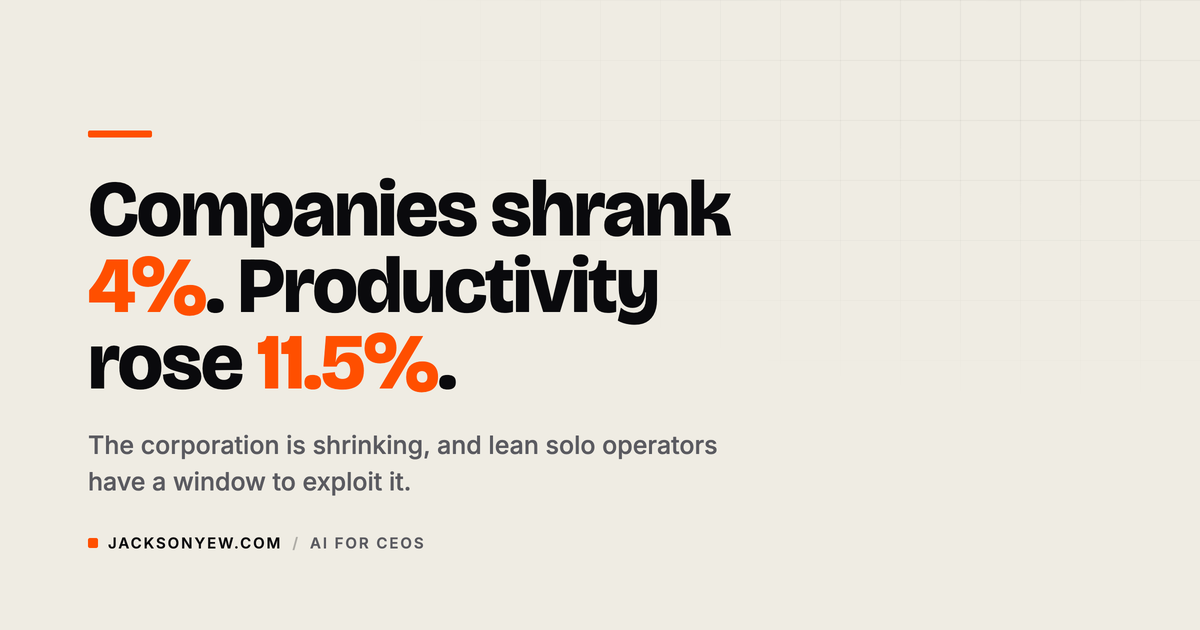
The average company shrunk its workforce by 4% over 12 months.
Productivity went up 11.5%.
This is not a hiring freeze. It is a redefinition of what a business is.
The mainstream AI conversation centers on job displacement. Fair enough. But that framing misses the more important structural shift happening underneath the surface.
The corporation is shrinking. The solo operator has a window right now that will not stay open indefinitely.
That is the efficiency paradox. And for anyone already running lean, it is the clearest structural advantage I have seen in years.
The Data Behind the Shift
Morgan Stanley's March 2026 TMT Conference brought together 1,000 executives across 5 countries. The net headline: 4% average workforce reduction directly attributable to AI. At the same time, productivity increased 11.5%.
Less input. More output.
Morgan Stanley's research goes further. At full AI adoption, efficiency gains could exceed 50% of estimated 2026 consensus pre-tax earnings in select sectors. That is not a productivity improvement. That is a structural redesign of what a company needs to function.
The public conversation about these numbers focuses on workers displaced. What gets less attention is what the numbers imply about the other side of the equation.
If a 10,000-person company can now produce more with significantly fewer people, the bottleneck for business output has permanently shifted. It is no longer headcount.
It is leverage.
And leverage favors the lean.
Why Timing Creates an Asymmetric Advantage
Large companies move slowly. That is not a criticism of leadership. That is physics.
A Fortune 500 company that decides to restructure around AI today will spend 18 to 24 months doing it. Change management programs. Department approvals. Legal review of AI usage policies. Technology rollouts across thousands of employees. HR retraining at scale.
Every step in that process is necessary for an organization that size. Every step also takes time.
You do not have that problem.
A solopreneur or small operator can audit every workflow, identify where AI creates leverage, and rebuild the operation around it in days. Not months. Days.
I did this exercise last year. Mapped out every recurring task in my content production and client operations. Identified which ones followed a repeatable pattern that AI could handle. Built workflows around those. The whole process took about a week of focused work.
What I got back: roughly 15 hours a week that now go toward the work that actually requires me. Strategy. Client relationships. Creative decisions that need genuine judgment.
The week I spent restructuring is still paying out, compounding, every single week.
While a large corporation is still scheduling the meeting to decide who owns the AI restructure initiative, you have already restructured.
Speed compounds. The window between "large companies start restructuring" and "large companies finish restructuring" is the window you have to move. For you, that window is measured in days and weeks. For them, it is measured in years.
The Efficiency Floor Changes the Game
Once AI handles the baseline work - research, drafting, scheduling, basic outreach, repetitive client communications, report generation - the competitive question changes fundamentally.
It used to be: how much can you produce?
Now it is: what is your judgment worth?
This is what I mean by the efficiency floor. AI raises the baseline for everyone. The output volume question gets answered by the stack. The quality and insight question remains entirely human.
For operators with real expertise and a genuine perspective, this is the best possible structural shift.
A decade ago, a 20-person content agency could out-produce a solo expert on sheer volume every time. That was a real structural advantage built on headcount.
Today, a solo expert with an AI stack can match the output volume. The competitive question becomes who produces the more valuable thinking. That is a different competition and one where depth wins over scale.
OpenAI surpassing $25 billion in annualized revenue signals one thing clearly: AI infrastructure is no longer in the experimental phase. The tools that used to be expensive pilots are now standard operating costs available to anyone.
The efficiency floor exists. It is accessible. The question is whether you are building above it while the large companies are still building their foundation.
The AI Restructure Sprint
If you want to move on this, here is the framework I would use. Three steps, one focused week.
Step 1: The Workflow Audit (Days 1-2)
Write down every task you completed last week that took more than 30 minutes. Next to each one, ask one question: does this follow a repeatable pattern?
If yes, it is a candidate for AI delegation. Research tasks. First drafts. Scheduling. Data entry. Basic client updates. Report generation.
Write all of them down without filtering. Most people significantly underestimate how many of their weekly hours go to pattern-based work until they actually document it.
Step 2: The Delegation Map (Days 3-4)
Take your list and map each task to a specific AI workflow. Not a hypothetical one. An actual tool and a prompt structure you can run today.
Research: Perplexity or Claude with a structured context prompt. First drafts: Claude with your voice guidelines and an output template. Scheduling: An automation platform connected to your calendar. Client reports: AI pulling from existing data sources, run through a standard template.
You are not building a perfect system on day four. You are building a working one. The first version runs at roughly 70% of your current quality. That is enough to start.
Step 3: The Handoff Test (Days 5-7)
Run each workflow for real. Not a demo. Actually hand the task off to the AI and review what comes back.
The output will not be perfect. That is expected. Your job this week is to define what "good enough to build on" looks like, and to document what adjustments the AI output typically needs.
That documentation becomes your process. Refine it once a week for a month. After four weeks, most of it runs without significant intervention.
The corporations spending 18 months on AI restructure are solving the same problem at 100x the scale. They have approval processes, legal review, stakeholder management, change management across entire departments.
You have one business to restructure. Same destination. Completely different timeline.
The Window Is Open. It Will Not Stay Open Indefinitely.
The efficiency paradox created a rare moment. Corporations are mid-restructure. The tools are accessible and mature. The floor is rising for everyone.
For anyone already operating lean, this is the asymmetric window. Not because AI is new, but because the gap between what a large organization can move and what a lean operator can move has never been wider than it is right now.
That gap narrows as enterprise adoption accelerates. The companies that were still in "AI strategy" meetings in 2024 are executing in 2026. The timing matters.
The question is not whether to rebuild your operation around AI. The question is whether you move while the window is still wide open.
If you want to work through the workflow audit and delegation map for your specific business, book a call with my team (https://jacksonyew.com/call). We do this together in one session and leave with a working restructure plan.
Related: Conversion Architecture and work with Jackson on business systems.
- Jackson
FAQ
What is the efficiency paradox?
It is the structural shift behind Morgan Stanley's finding that the average surveyed company shrank its workforce by 4% over twelve months while productivity rose 11.5%. Less input, more output. The bottleneck for business output is no longer headcount, it is leverage, and leverage favors lean operators.
Why do small operators have a timing advantage over large companies right now?
Large companies move slowly by physics, not bad leadership. A Fortune 500 restructure around AI takes 18 to 24 months of change management, approvals, legal review, and retraining at scale. A solo operator can audit every workflow and rebuild around AI in days. The gap between what a corporation can move and what you can move is the asymmetric window.
If AI lets everyone produce more, what stops it from being a race to the bottom?
AI raises the baseline output for everyone, which the article calls the efficiency floor. Once volume is answered by the stack, the competition shifts to whose judgment and insight is worth more. A decade ago a 20-person agency out-produced a solo expert on volume. Today a solo expert with an AI stack can match that volume, so the contest becomes depth over scale.
How long does an AI restructure sprint take?
One focused week, in three steps. Days one and two are the workflow audit, listing every task over 30 minutes and marking the ones with repeatable patterns. Days three and four map each task to an actual tool and prompt. Days five to seven run each workflow for real to define what good enough looks like. The first version runs at roughly 70% quality, which is enough to start, then you refine weekly for a month.
Sources
- How AI Is Driving Efficiency Gains (AI Adoption Surges Driving Productivity Gains and Job Shifts) Morgan Stanley · March 1, 2026
- AI job displacement 2026: Morgan Stanley TMT Conference warns of workforce crisis Fortune · March 12, 2026
- OpenAI tops $25 billion in annualized revenue, The Information reports Reuters (via Yahoo Finance) · March 5, 2026