
Key takeaway
Most Google searches now end without a click as AI answers them directly, so visibility increasingly depends on being cited inside AI engines, not just ranking links in classic search.
Updated : Refreshed source citations, internal links, and formatting throughout.
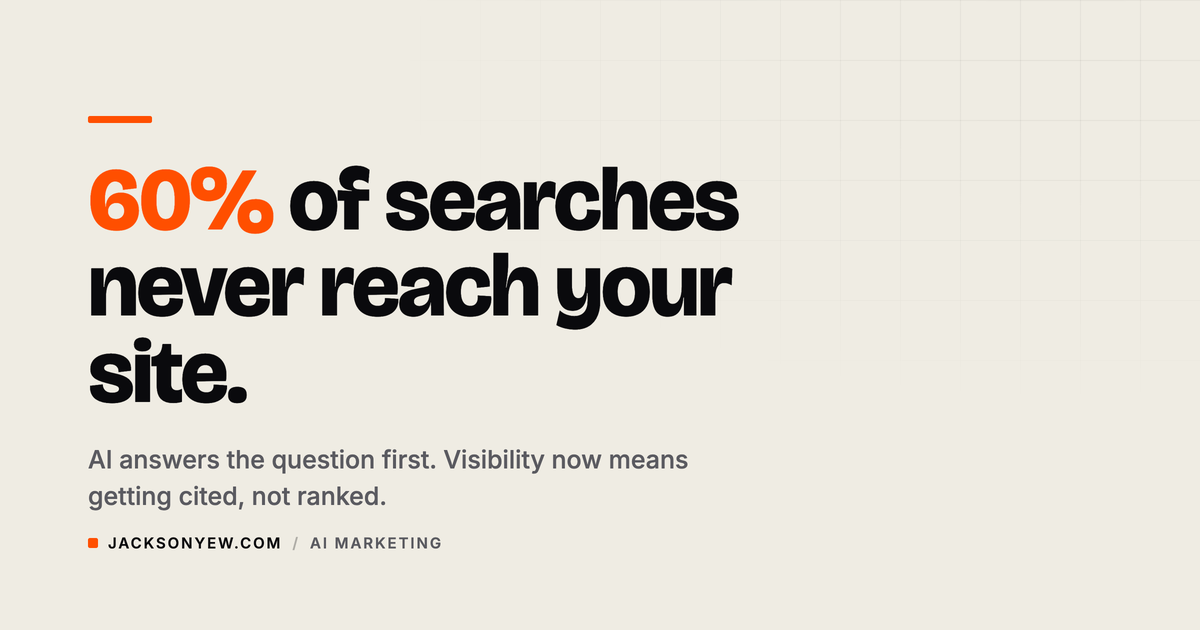
Roughly 60% of Google searches now end without a single click.
Not because people aren't interested. Because AI already answered the question.
This is not a Google problem. ChatGPT, Perplexity, Gemini, Meta AI - every major AI engine is now a discovery channel. And most of the time, the searcher gets their answer before they ever reach your website.
If your entire discovery strategy is built around Google rankings, you are optimizing for the shrinking minority of searches that still end in a click.
The good news: the new game favors individual experts more than it favors any content farm. The algorithm that used to reward scale now rewards genuine authority.
The Zero-Click World
For 15 years, the discovery path was simple. Write good content. Rank on Google. Get clicks. Build audience.
That path still works. For the searches where someone clicks.
The majority now resolves inside an AI engine. The searcher asks a question. The AI synthesizes an answer from across the web. The searcher gets what they needed and moves on. The websites that fed the answer never received the visit.
This shift is not coming. It already happened.
It started with Google's AI Overviews. It accelerated when ChatGPT became a primary search interface for millions of people. By early 2026, most queries across professional and business topics resolve in Perplexity, ChatGPT, Gemini, or Meta AI before reaching a traditional search results page.
The Stormy.ai GEO Playbook 2026 puts the zero-click rate at 70% across AI search engines. Enrich Labs' GEO Complete Guide confirms the same data from a different angle: enterprise marketing teams already have dedicated GEO programs. Most individual operators and small marketing teams have not started.
That is the first-mover window. It is still open.
What GEO Actually Requires
GEO stands for Generative Engine Optimization. It is the practice of making your content the cited answer inside AI search systems.
It sounds like SEO with a different acronym. The mechanics are different in ways that matter significantly for individual experts.
SEO rewards domain age, backlink quantity, content volume, and site authority built over years. A brand-new site from an independent expert is at a structural disadvantage against a well-funded content operation with years of accumulated authority.
GEO rewards four different signals.
Named author authority. AI systems penalize anonymous content. When an AI engine decides which sources to cite, it looks for content attached to a specific, verifiable expert. Anonymous bylines - the "Staff Writer" approach that corporate content farms use for efficiency - get deprioritized. Your name on your content is an advantage, not a liability.
Direct answer structure. AI engines look for content that answers the specific question in the first paragraph. Not a 500-word setup before getting to the point. The answer first, then the context. This is the Pyramid Principle applied to search optimization.
Original data or observations. AI systems cite sources that bring new information to a topic. Not sources that aggregate what others have already written. Your own case study results, specific numbers from your own business, observations from your own experience - these are the signals that make your content worth citing.
Third-party citations. When other credible sources link to or reference your content, it signals verifiability. This is the only overlap with traditional SEO, and it is the fourth signal, not the first.
None of these require domain age. None require an ad budget. None require a content team.
Search Engine Land's "Mastering generative engine optimization in 2026" guide makes the broader point clearly: the factors that determine AI citation - entity authority, content structure, original research, and freshness - are the factors that favor real experts over production-line content.
A specialist with five years of genuine expertise and a consistent content archive can outrank a corporate content team with ten times the budget. That is not optimism. That is what the GEO signals actually reward.
Why This Is the Best News Experts Have Had in Years
I checked my own content against these signals last year. The honest answer was that I had been building for the wrong game.
Most of what I had published was structured for Google. It assumed someone would click, land on the page, and read through to the end. Good SEO structure. Wrong optimization target for where most queries actually resolve.
The content I had that performed best on GEO signals was the content I had written in my own voice, from my own experience, with specific observations that came from actually running my own business. Not the synthesized overviews. The specific posts.
This is consistent with what the data shows across the board.
Corporate content factories built their competitive advantage on production volume. More content, more backlinks, more domain authority over time. The race had a high cost of entry and rewarded whoever had been at it longest.
GEO is a different race entirely.
AI engines do not need to read 50 articles on a topic. They need to find the one that answers the question with the highest credibility signal. Named author. Specific answer. Original information. Verifiable by third-party reference.
A specialist who writes one genuinely expert piece a week, under their own name, answering specific questions directly, with observations from their own work... consistently outperforms the anonymous content farm on every GEO signal.
Enrich Labs reports that enterprise teams already have GEO programs running, while most SMB marketing teams have not started. The window for building citation authority before it gets crowded is still measurably open.
The GEO Audit
Before restructuring your content strategy, run this audit. Five questions to determine if your current content would be cited by an AI search engine today.
1. Is your name on your content?
Not a brand name. Your actual name, with a bio that establishes your specific expertise. If you have been using a company name as your author, change it. Named authorship is the first GEO signal and the easiest to fix.
2. Does the first paragraph answer the question your title implies?
Take your last three posts. Look at the opening paragraph. Does it answer the question directly? Or does it set context for several hundred words before getting to the point? The answer should be in the first 100 words.
3. What original information does your content contain?
Not a summary of what others have written. Your own data. Your own observations. Your own case study results. Your own specific numbers from your own business. If your content is primarily synthesizing other sources, AI already has those sources and does not need to cite you.
4. Are you answering specific questions your audience actually searches?
Not broad thought leadership. Specific questions with specific answers. "What is GEO and how does it work for personal brands?" is a specific question. "Thoughts on modern marketing" is not. Your content calendar should map to the actual questions your audience types into AI engines.
5. Are you publishing consistently enough to signal active authority?
AI systems weight recent, regularly updated content differently than an archive that hasn't been updated in two years. Consistency is a credibility signal. Not volume - consistency.
If most of your answers reveal gaps, the good news is that fixing GEO alignment does not require starting over. It requires restructuring what you are already producing.
The Strategic Shift
The SEO work you have done for the past decade still matters for the searches where someone clicks. Do not abandon it.
But most of your potential audience is finding answers inside AI engines. Either your content is the cited answer, or your competitor's content is.
The game is not harder for individual experts than it was before. For people who have been building real expertise and publishing it consistently, GEO is the first search optimization system that actually rewards what they have been doing all along.
The window to get there before it is crowded is still open.
If you want to audit your current content strategy against GEO signals and map the restructure, book a call with my team (https://jacksonyew.com/call). We walk through the five questions together and leave with a specific action plan.
Related: how Jackson runs AI agents as an executive team and work with Jackson on AI systems.
- Jackson
FAQ
What does a 70% zero-click rate mean for my website traffic?
It means 70% of searches in 2026 end without anyone clicking through to a site. The searcher asks a question, the AI synthesizes an answer from across the web, and they move on. The websites that fed that answer never get the visit. If your discovery strategy is built only on Google rankings, you are optimizing for the shrinking 30%.
How is GEO different from SEO?
SEO rewards domain age, backlink quantity, content volume, and site authority built over years, which structurally favors well-funded content operations. GEO, or Generative Engine Optimization, rewards four different signals: named author authority, direct answer structure, original data or observations, and third-party citations. None of those require domain age, an ad budget, or a content team.
Why does GEO favor individual experts over content farms?
AI engines do not need to read 50 articles on a topic. They need the one that answers the question with the highest credibility signal: a named author, a direct answer, original information, and verifiable third-party references. Anonymous Staff Writer bylines get deprioritized. A specialist publishing one genuinely expert piece a week under their own name outperforms an anonymous content farm on every GEO signal.
How do I check whether my current content would get cited by an AI engine?
Run the five-question GEO audit. Is your actual name on your content? Does the first paragraph answer the question your title implies, within the first 100 words? What original information does the content contain? Are you answering specific questions your audience actually searches rather than broad thought leadership? Are you publishing consistently enough to signal active authority? Gaps in the answers show what to restructure.
Sources
- 2024 Zero-Click Search Study: For every 1,000 US Google Searches, only 360 clicks go to the Open Web SparkToro · July 1, 2024
- The 2026 Playbook for Generative Engine Optimization (GEO): Getting Cited by Perplexity and Gemini Stormy AI Blog · January 1, 2026
- Generative Engine Optimization (GEO): The Complete 2026 Guide to Ranking in AI Search Enrich Labs · January 1, 2026
- Mastering generative engine optimization in 2026: Full guide Search Engine Land · January 1, 2026
- How to Optimize Content for AI Search Engines [2026 Guide] Semrush · January 1, 2026
- AI Search Citation Benchmarks: What Gets Cited [2026 Data] Averi · January 1, 2026